Synthetic identity fraud in insurance works because fabricated and stolen identities are built to pass the checks carriers rely on. Insurers have spent a decade getting better at verification. Applicants are checked against identity databases, employees pass background checks, policyholders pass multi-factor authentication, and claimants are matched to policies. Each check answers one question: are these credentials valid right now?
Synthetic and stolen identities are built to answer yes. The Coalition Against Insurance Fraud’s 2026 report on synthetic and stolen identification describes fabricated identities “designed to pass automated screening systems, background checks, and human review,” and insiders who already hold legitimate access. In both cases the check passes, and the fraud happens afterward.
A verified identity tells a carrier the credentials were right. It does not tell the carrier who is actually in the session, whether they behave like the person they claim to be, or what they are trying to do. Those answers come from how the session unfolds, not from the credentials presented at the door.
We argue the following:
- Point-in-time checks (identity proofing, document verification, MFA, device ID) are necessary, and they are not enough on their own, because the fraud happens after them.
- The stronger signal is continuous: behavioral, device, network and IP signals read together across a session, compared with how genuine people and the account owner normally behave.
- Carriers that treat intent, not identity alone, as the thing to verify can stop more fraud while letting genuine customers, employees and agents through with less friction.
In this article, we provide a practical playbook for SIU, claims, servicing and digital leaders, and a future look at what changes as AI agents start attempting synthetic identity fraud and carrying stolen credentials on someone else’s behalf.
Prefer a PDF?
Download the white paper version of this article, Verified Is Not the Same as Trustworthy, to share with your fraud, claims and digital teams.
The problem: synthetic and stolen identities are built to pass
In 2026 the Coalition Against Insurance Fraud’s Property and Casualty Task Force published a report on synthetic and stolen identification fraud. It separates two threats that are often lumped together:
- Synthetic identity fraud: “the creation of a fictitious identity, typically by combining real personal data (such as a valid Social Security number) with fabricated information.” AI now lets fraudsters build these identities from entirely fabricated data, “supported by convincing documentation produced through image generation and manipulation tools.”
- Stolen identification: the misuse of a real customer’s or colleague’s personal information, including “diverting payments, opening fraudulent accounts, or accessing restricted systems.”
The report’s key observation is about design intent. Synthetic identities “are designed to pass automated screening systems, background checks, and human review.” A fraudster who builds an identity to pass a check is not deterred by the check – the check is the specification.
The cost of building one has collapsed. The report lists what fraudsters can now produce with generative AI: realistic government-issued IDs, resumes that pass applicant tracking systems, “complete digital footprints including professional profiles, email accounts, and online histories,” and “synthetic voice and video personas capable of conducting real-time phone calls and video interviews.” Citing the FBI’s Internet Crime Complaint Center, it notes that IC3 “received more than 22,000 complaints reporting AI-related information” in 2025, with “adjusted losses” exceeding “$893 million.”
The Coalition also explains why insurers are a prime target: they “routinely collect and store vast quantities of PII,” claims systems “rely on automated workflows,” remote work “has reduced in-person verification touchpoints,” and “complex vendor and agent networks create multiple entry points where identity controls may be inconsistent or inadequate.”
Investigators are already stretched. In the Coalition’s 2024 Insurer SIU Benchmarking Study, conducted by Aon across 35 P&C carriers, automated detection tools generated 45% of all SIU referrals while SIU staffing “grew an average of just 0.5%,” Insurance Business reported. The Coalition named account takeovers and synthetic IDs among the emerging schemes attached to organized fraud. More alerts are not the answer. Better ones are.
Where synthetic identity fraud shows up in insurance
Stolen identities and synthetic identity fraud are usually discussed as an onboarding problem. The Coalition’s report shows they travel much further, across customers, employees, agents and claims. In every row below, a check passes and the damage happens afterward.
| Where | What the fraud looks like | The check it passes | Where the loss happens |
|---|---|---|---|
| New business | A synthetic applicant, or a real person’s stolen details, used to bind a policy | Identity database match, document verification | Early-term claims, premium never paid, a policy used as a foothold |
| Policyholder servicing | A fraudster logs in with stolen credentials and changes contact or payout details | Password plus MFA | The next refund or claim payment goes to the fraudster |
| Claims | Synthetic policyholders fed into automated workflows, or claims sized to stay under review thresholds | Policy match, automated approval rules | Paid “without triggering manual review,” in the report’s words |
| Agents and brokers | Fraudulent policies, diverted commissions, manipulated policyholder data | Producer licensing and portal login | Commission and premium leakage, tainted books |
| Employees and contractors | A synthetic hire, or an insider with legitimate access harvesting PII or working with a fraud ring | Background check, video interview, SSO | Data sold to fraud networks, payments redirected, credentials handed to outsiders |
Two patterns run through the table.
First, the attacker’s goal is to look routine. The report notes fraudsters “using AI tools to identify patterns in automated approval thresholds and submitting claims calibrated to avoid triggering fraud detection rules.” A rules engine sees a normal claim. A login check sees valid credentials.
Second, the inside and the outside are connected. The report describes “collusion networks” in which internal bad actors work “in concert with external fraud rings, providing access credentials or data exports in exchange for payment.” Stolen employee data becomes synthetic customer identities. Stolen customer credentials become account takeovers. A carrier that watches only one channel sees only one piece of the scheme.
Why point-in-time checks miss synthetic identity fraud
Every standard identity control asks its question once, at a gate. That made sense when forging an identity was expensive and stealing one was rare. Neither is true now.
| Control | What it confirms | What it cannot tell you |
|---|---|---|
| Identity proofing and database checks | The data points exist and belong together | Whether the person entering them is the person they describe |
| Document verification | The ID image looks authentic | Whether an AI produced it; the report warns that manipulated artifacts are “increasingly difficult to identify without specialized tools” |
| Background checks and video interviews | The candidate’s history and face hold up | Whether the history was fabricated or the face was a deepfake persona |
| Passwords and MFA | Someone presented valid credentials at login | Who is driving the session after login, and what they intend to do |
| Device ID and IP reputation | The device or network has been seen before, or looks risky | Whether a familiar device is being used by someone new, or a clean one by a fraud ring |
| Rules and automated approval thresholds | The transaction fits known patterns | Whether it was deliberately shaped to fit them |
None of these controls are wrong. The Coalition is explicit that “no single solution is sufficient” and recommends layering them. The issue is timing. Each control looks at a snapshot taken at the door. Synthetic and stolen identities are built to look right in that snapshot, and the harmful action (the payout change, the bulk export, the calibrated claim) comes later.
The report points toward the missing layer itself. Among its recommendations: analyzing interaction behavior “as a secondary identity signal for ongoing authentication,” and “monitor for anomalous data access behavior.” The operative word is ongoing. Verification asks who someone claims to be. The harder question, and the one fraud depends on carriers not asking, is whether the session behaves like that person, and what it is trying to do.
What works for synthetic identity fraud: verify intent, not just identity
The answer is not another gate. It is a layer that keeps watching after the gates have passed, and that judges a session by how it behaves rather than by the credentials it presented. Four principles separate this approach from the controls above.
1. Read the whole session, not just the credentials
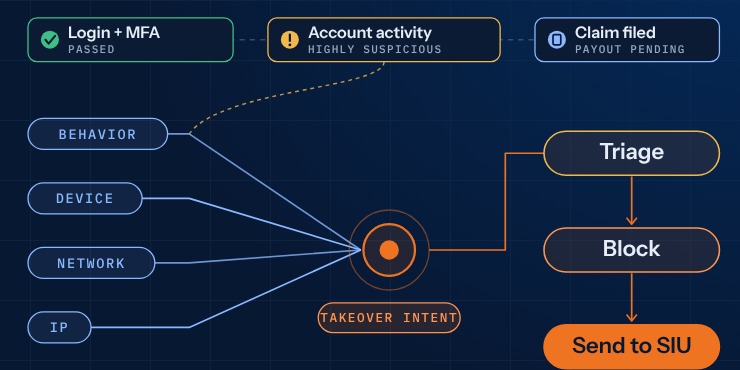
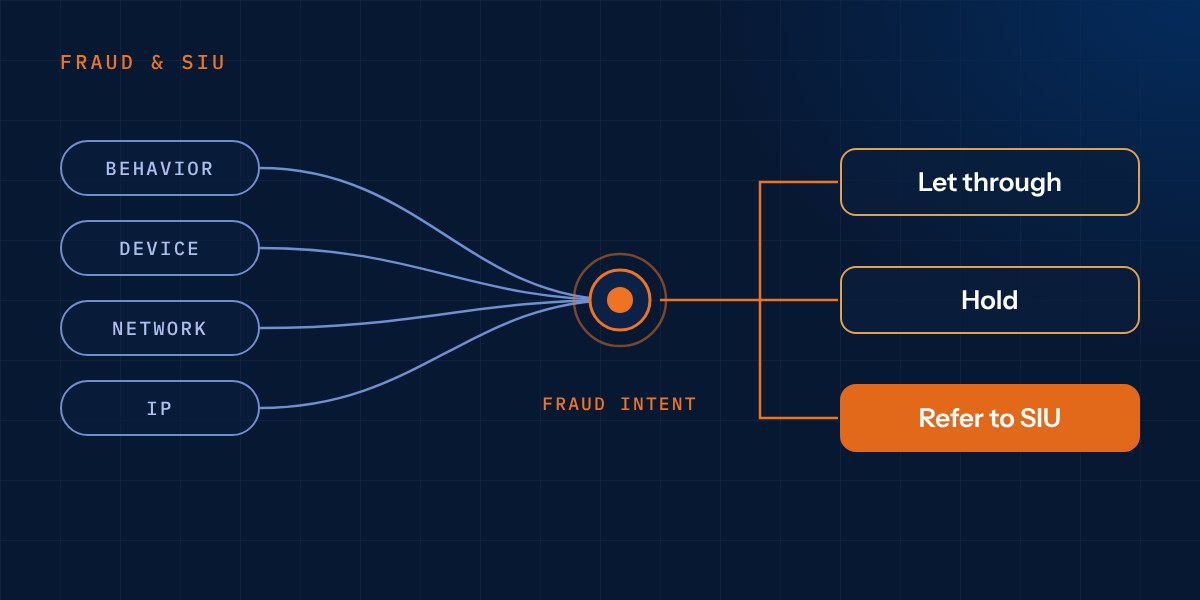
How someone moves through a form or a portal carries information that a forged document or a stolen password does not. Behavioral signals become far more useful when they are read together with device, network and IP signals across hundreds of features, because a fraudster can fake any one of them but rarely all of them at once.
2. Compare against the right baseline
A brand-new identity has no history, so its session is compared with how genuine applicants behave, including whether the person on screen behaves like someone who actually knows the identity they are using. An existing account is compared with its owner’s own history. An employee or agent is compared with the norms of their role. The question changes from “are these credentials valid?” to “does this behave like the person, and the kind of person, it claims to be?”
3. Follow the identity across channels
Synthetic and stolen identities rarely act once. One device opening many unrelated accounts, an applicant who reappears at claims, a servicing session that resembles a known fraud ring: these links are invisible to a control that sees one transaction in one channel. They become visible when application, servicing, claims and internal sessions are read as one behavioral record.
4. Determine intent, then act in proportion
Most sessions are genuine, and they should move through without friction. The goal is not to flag more. It is to separate the routine payout change from the takeover, the shopper from synthetic identity fraud, the busy adjuster from the insider exporting records, and then respond under the carrier’s own rules: let it through, add step-up verification, hold a payment for review, or route it to SIU with the evidence attached. That is how carriers get fewer, better referrals into investigation teams that are not growing.
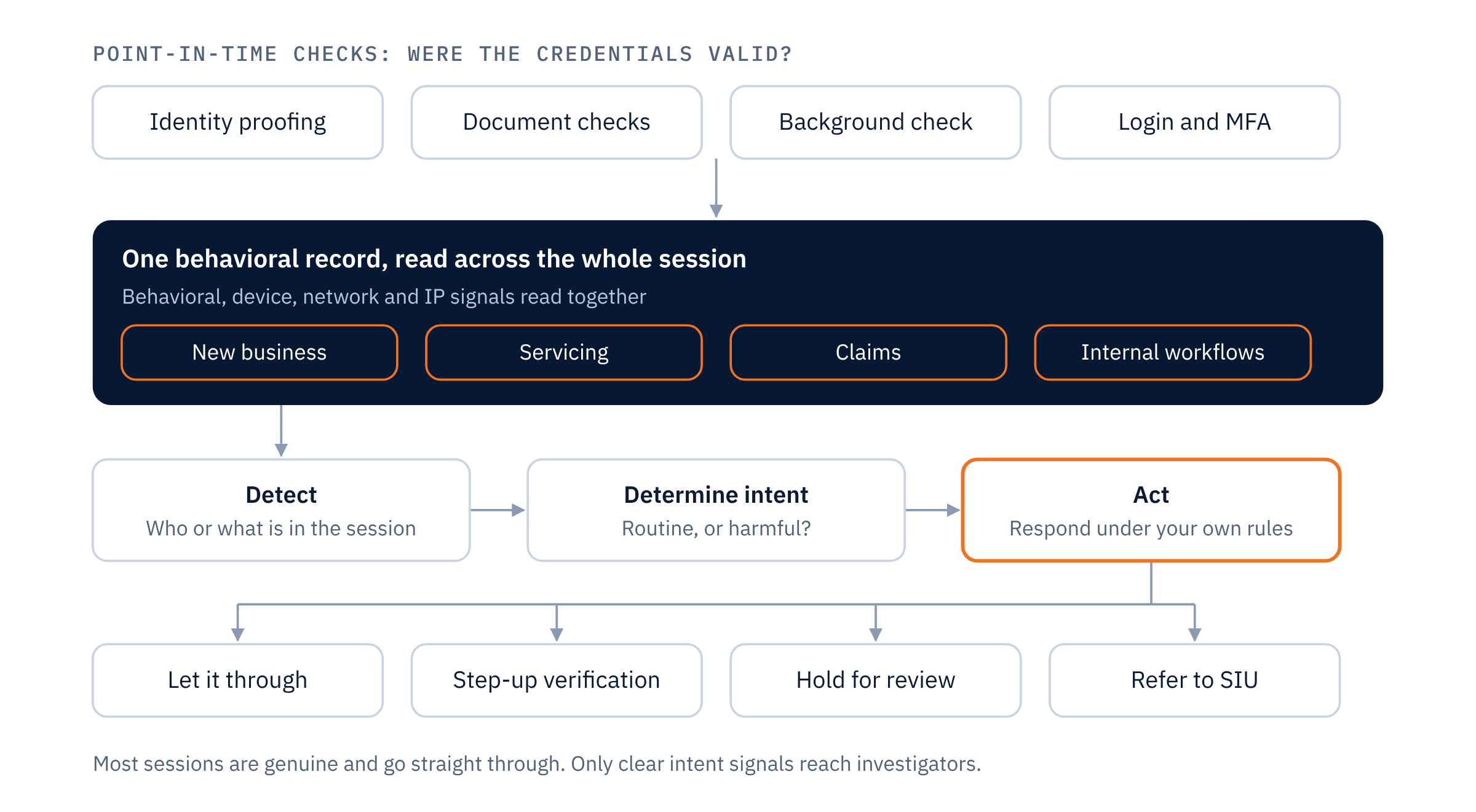
The gates still matter. The decision about what a session is allowed to do comes from what happens after them.
How ForMotiv applies this
ForMotiv reads behavioral, device, network and IP signals together inside carriers’ own digital experiences, then helps teams detect high-risk sessions, determine intent and act in real time. Carriers use it today across new business applications, policyholder and benefits portals (registration, login and account changes), and claims. The same approach can extend to internal employee workflows, where the Coalition’s recommendation for ongoing behavioral authentication applies directly.
ForMotiv is trusted by 7 of the top 10 P&C carriers and several additional top 10 life carriers to do just this.
A playbook for fraud, claims and digital leaders
These steps build on the Coalition’s recommendations and focus on the gap between a passed check and a trustworthy session.
- Map where money and data move after verification. List every action that changes a payout account, contact detail, beneficiary or address, issues a payment, or exports personal information. These are the moments that matter, and most sit well after login.
- Find the checks that run only once. For each of those actions, note what was last verified and when. Anything protected only by a login that happened earlier in the session is exposed to account takeover and insider misuse.
- Add a continuous signal at those moments. Read behavioral, device, network and IP signals across the session, not only at the gate, so the session that changes a payout account is judged on its own behavior.
- Use the right comparison for each population. New applicants against genuine applicants, policyholders against their own history, employees and agents against their role. One baseline for everyone produces noise.
- Connect channels into one behavioral record. Link application, servicing and claims activity so a device or behavior pattern seen in one place is visible in the others. This is where synthetic identities and fraud rings show themselves.
- Decide responses before you need them. Agree with underwriting, claims and customer experience on what happens at each risk level: pass, step-up, hold or refer. Proportionate responses keep genuine customers moving.
- Send SIU fewer, better referrals. Route only sessions with a clear intent signal, with the session evidence attached, so investigators spend their time on cases rather than triage.
- Audit automated thresholds regularly. As the report recommends, review approval workflows for patterns fraudsters may be exploiting, including claims clustered just under review limits.
- Share what you learn. The Coalition calls for “shared threat intelligence” across insurers, TPAs, agents and vendors. Anonymized patterns from one carrier’s sessions can warn the next.
What’s next: agents carrying someone else’s credentials
The gap between verified and trustworthy is about to widen. Consumers are starting to hand AI agents their logins so the agent can shop, quote, file and update policies for them. Many of those agents act for genuine customers. Some will act for fraudsters, carrying stolen credentials and synthetic identities through portals at a human-like pace and at a scale no fraud ring could staff.
That breaks an assumption most identity controls still make: that the entity presenting valid credentials is a person, and probably the right one. An agent can hold a real policyholder’s password and pass MFA through a relayed code. Network-level controls tend to catch the agents that identify themselves, and the ones that don’t can look like ordinary visitors.
The principle in this article applies unchanged. Detect whether a person, a person using an assistant, or an autonomous agent is in the session. Determine whether its intent is routine or harmful. Act in proportion. Blocking every agent would turn away customers who chose a new tool; trusting every agent with valid credentials would hand fraudsters a new one. ForMotiv’s agentic AI detection is live today, and we are tracking 100+ web-capable AI agents. More on how to detect AI agents in insurance applications.
Get the white paper
Download Verified Is Not the Same as Trustworthy (PDF), or contact woody@formotiv.com to see how carriers close the gap between a passed check and a trustworthy session.
Sources
- Coalition Against Insurance Fraud, Property and Casualty Task Force, Synthetic and Stolen Identification (2026). All quotations from the report, including its citation of FBI IC3 figures. insurancefraud.org
- FBI Internet Crime Complaint Center, 2025 Internet Crime Report, as cited in the Coalition report.
- Kiernan Green, “Automated tools now make 45% of SIU referrals. Investigators haven’t kept pace,” Insurance Business, Nov 9, 2026.