Underwriting

Two applications can have identical answers and completely different risk.

Underwriting has always priced the answers. ForMotiv adds how they were given: what changed as they went, and what came back different on a later visit. You see misrepresentation, premium leakage and nondisclosure in session, in real time, and after the quote.

What you see
Auto quote · clean
7:12 PM
Quote started

Applicant begins an auto quote online.

Fourteen minutes of answers and edits, then a return visit two days later. Only the final values reach your systems.

7:26 PM
Quote returned

$1,042 for six months.

+2 days
Bound

Applicant comes back and buys online.

Drivers

1

Vehicle use

Commute

Prior carrier

3 years

Garaging ZIP

19103

OutcomeBinds as submitted at $1,042
What ForMotiv sees
Same applicant
7:12 PM
Quote started

Session established; device and network recorded.

7:15 PM
Household drivers

Paused 11 seconds on “Any other drivers?” and answered No.

Undisclosed driver
7:19 PM
Vehicle use

Picked Business, then switched to Commute before moving on.

Misrepresentation
7:24 PM
First quote shown

$1,388 for six months.

7:26 PM
Prior carrier

Tenure changed from 8 months to 3 years.

Rate evasion
+2 days
Return visit

Same device. Moved the garaging ZIP, then bound.

Location gaming
Recommended action Verify drivers and garaging before issue

High-risk signals fired during the session and on the return visit.

One illustrative application of many. Some changes happen before a price is ever shown, and some days later. ForMotiv captures both.

What underwriting teams use ForMotiv for

Three ways a policy gets mispriced before anyone looks at it

Three of many. Each leaves a different behavioral trail, and ForMotiv captures it in session, in real time, and after the quote, including return visits. Version history can tell you what changed between saves. ForMotiv shows the behavior behind it, as it happens.

P&C · rate evasion

Premium leakage

Drivers left off, mileage trimmed, garaging moved and tickets deleted, whether that happens while the form is being filled in, after a price appears or on a later visit.

A few examples

Undisclosed drivers

Mileage

Garaging

Violations

Discounts

and more

Premium leakage & rate evasion →
Every line · eligibility

Misrepresentation

Answers rewritten to get past an eligibility rule, in the same session or in a fresh one after a kickout: commercial use hidden as personal, prior carrier swapped.

A few examples

Kickout & rewalk

Vehicle use

Prior carrier

Prefill overrides

and more

Quote & bind →
Life · disclosure

Nondisclosure

Tobacco, alcohol, weight and medical history answers that the applicant's own behavior contradicts, captured on the question as it's answered.

A few examples

Tobacco & nicotine

Alcohol

Weight / BMI

Medical history

and more

Life nondisclosure →

Outcome predictions

Some risk only shows up after bind. ForMotiv sees it coming at the quote.

Beyond flagging bad answers, ForMotiv predicts how an application is likely to turn out, so you can act before the policy is in force. A few of the underwriting risk models carriers use:

Model

Early claims

Likely to file a claim in the first weeks after bind.

What you can doRoute for review or verify before the policy goes in force.

Model

Non-payers

Likely to miss the first payment, or stop paying soon after.

What you can doRequire a down payment or change the payment plan offered.

Model

Flat cancels

Likely to cancel inside the first 30 days, often after a claim or a coverage check.

What you can doHold the bind until payment or documents are confirmed.

Model

Early churn

Likely to leave before you earn back what it cost to acquire them.

What you can doTrigger onboarding or retention outreach early, or adjust acquisition spend.

Model

Uprates

Likely to be re-rated upward once the real drivers, vehicles or garaging come out.

What you can doVerify the rating answers that moved before you issue, not after.

Model · risk + growth

Comp & Collision

Predict the coverage a customer is most likely to end up choosing.

What you can doQuote the right coverage up front, so you price the real risk and more shoppers convert.

Agent-written business

Agents and agencies are your best sellers. They can also be your biggest underwriting liability.

Nobody knows your application, your rules and your rating engine better than the agents who use them every day. Most use that knowledge to write good business. A few use it to write business your guidelines were built to stop, and they're far better at it than any applicant.

ForMotiv reads every agent session, and benchmarks each agent and agency against their peers and against their own history.

An experienced agent knowsWhat ForMotiv sees

Which answers move the price Rating answers reworked across quote after quote
What triggers a referral Answers that steer around review, again and again
How to get past a kickout Restarts with the blocking answer changed
Which discounts nobody checks Discounts applied with nothing on file to support them

Benchmarked, not guessed. This agency removes young drivers at 3.4× the peer rate, and twice its own rate from last quarter.

ForMotiv Console

Underwriting teams work the patterns offline, too

Real-time signals handle the application in front of you. The Console is where underwriting teams find where leakage concentrates and decide what to change.

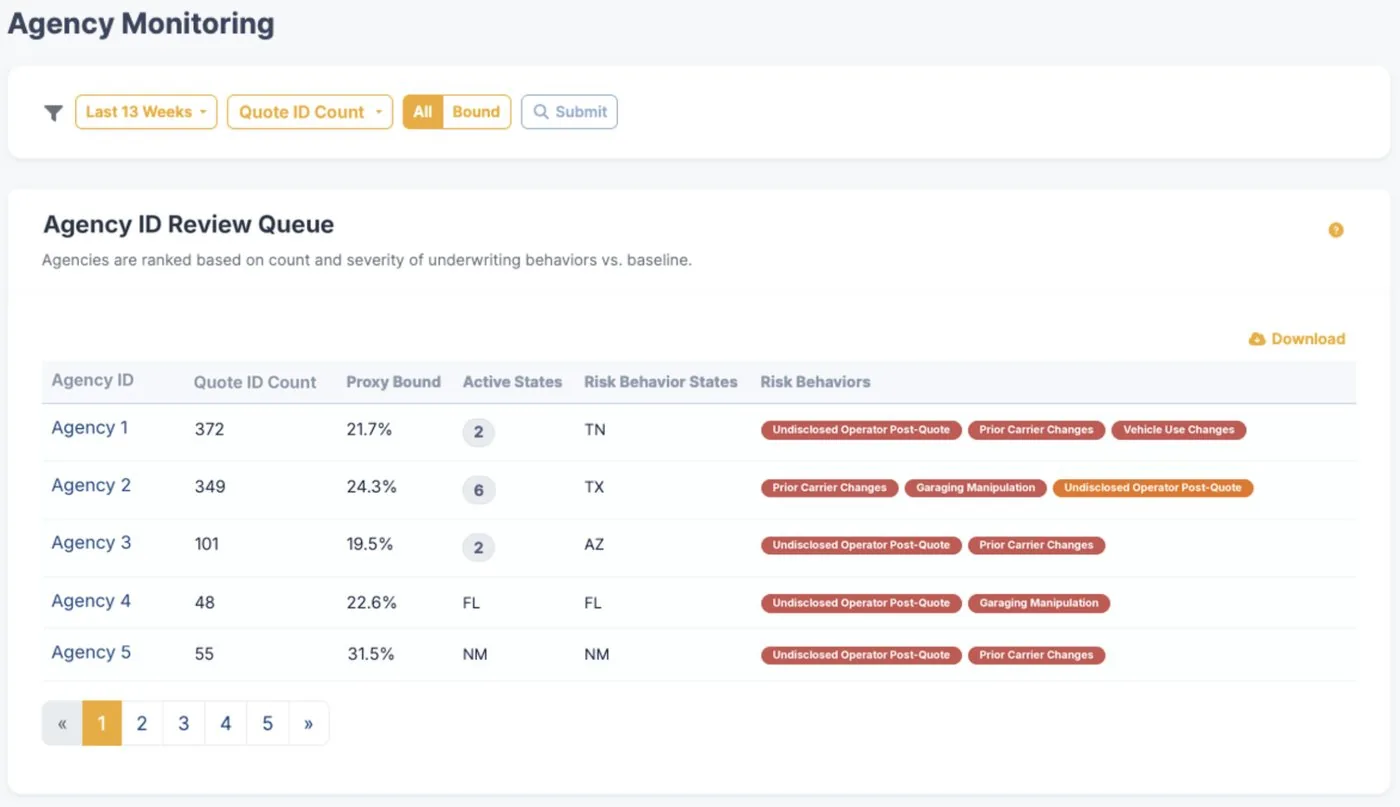
Rank agents and agencies by count and severity of risk behaviors

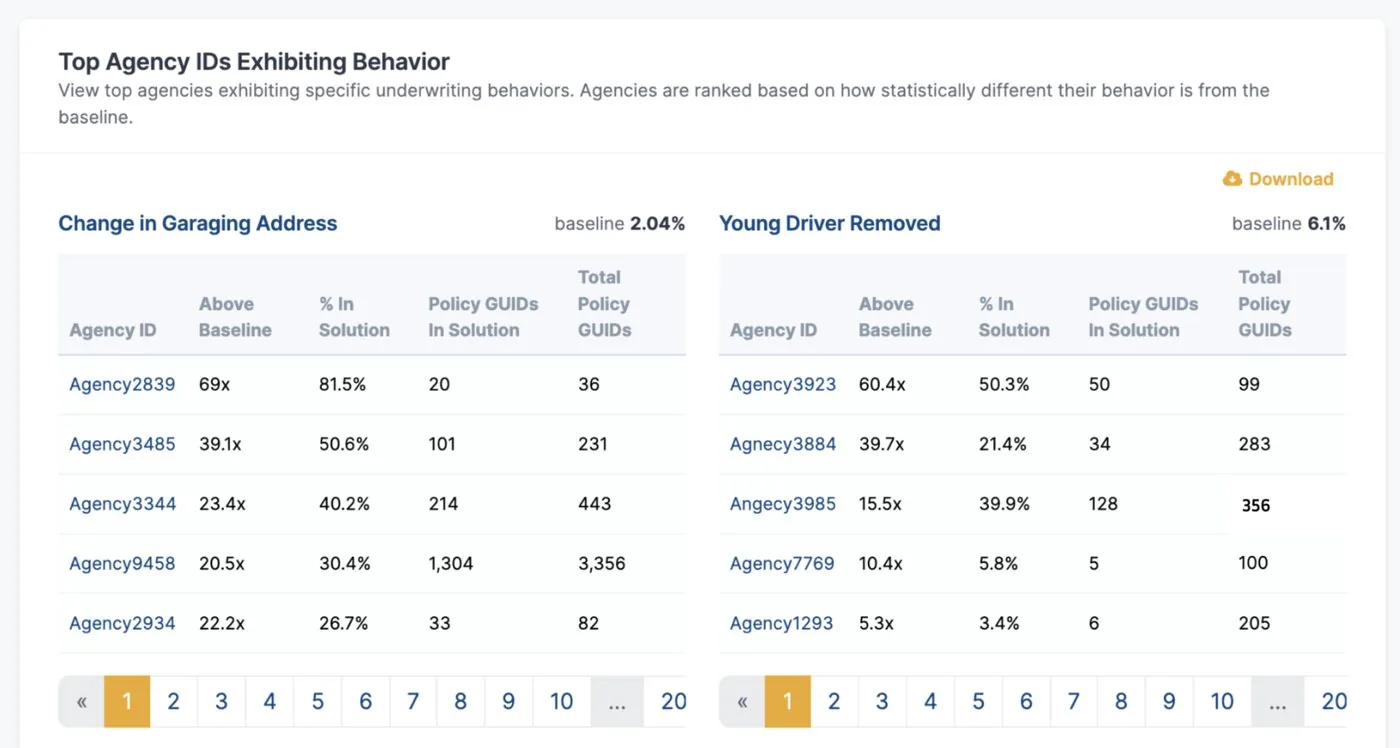
Compare a behavior, like a young driver removed, against its baseline rate

Slice by channel, state, product and quote type

Export lists for audits, agent management and guideline reviews

How teams use the Console →
ForMotiv Console · Agent & agency review queue
Agency ID review queue listing five agencies with quote counts, proxy bound rate, active states, risk behavior states and risk behaviors such as undisclosed operator post-quote, prior carrier changes and garaging manipulation.
ForMotiv Console · Top agents and agencies by behavior
Top agency IDs exhibiting behavior: tables for change in garaging address and young driver removed, ranking agencies by how many times above baseline they are.

Your rules and models

Keep your rating engine. Give it what the application data never had.

Use ForMotiv's signals as rules on day one, or add a DataPack to the underwriting models you already run. A DataPack is the set of behavioral features most predictive for that model.

What you use today

Rating answers MVR & CLUE Credit-based insurance score Prefill & vehicle data

+

ForMotiv

Signals: explainable rules, live day one DataPack: most predictive behavioral features for your model Reasons with every result

→

Your decisions

Bind, verify or refer Order data only when it pays Price for the real risk
Signals you can act on day one

Out-of-the-box behavioral rules built from ForMotiv's insurance expertise, configurable to your guidelines and refined with your outcome data.

Features for your own models
Explainable by design

Every flag arrives with the behaviors behind it, so a referral can be defended to an underwriter, an agent or a regulator.

FAQ

Frequently asked questions

How does ForMotiv help insurance underwriting?

ForMotiv adds how application answers were given to what was answered, so underwriting teams can see misrepresentation, premium leakage and nondisclosure in session, in real time, and after the quote.

Which underwriting risk models does ForMotiv support?

Carriers use ForMotiv models for early claims, non-payers, flat cancels, early churn, uprates and coverage prediction, among others, refined with their own outcome data.

What is the difference between misrepresentation and premium leakage?

Premium leakage is underpricing caused by inaccurate rating answers. Misrepresentation is broader: answers rewritten to get past an eligibility rule, such as hiding commercial use or changing the answer that caused a decline.

Does ForMotiv replace a carrier's rating engine?

No. Carriers keep their rating engine and models and add ForMotiv signals as rules or DataPacks as model inputs.

How do underwriting teams use the ForMotiv Console?

Underwriting teams use the Console offline to find where risk behaviors concentrate, compare behaviors against baselines, rank agents and agencies, and export lists for audits and guideline reviews.

Your applications already know more than they say.

Bring one journey and one goal. We’ll show you the behavioral signals behind it, the decisions they can drive, and how ForMotiv fits into your stack.

01
Pick the use case

Leakage, fraud, conversion or agent oversight, on the line and channel you care about most.

02
See it on a real flow

A walkthrough of the signals, features and scores for journeys like yours.

03
Map the integration

Where the tag goes, what the API returns and which systems act on it.